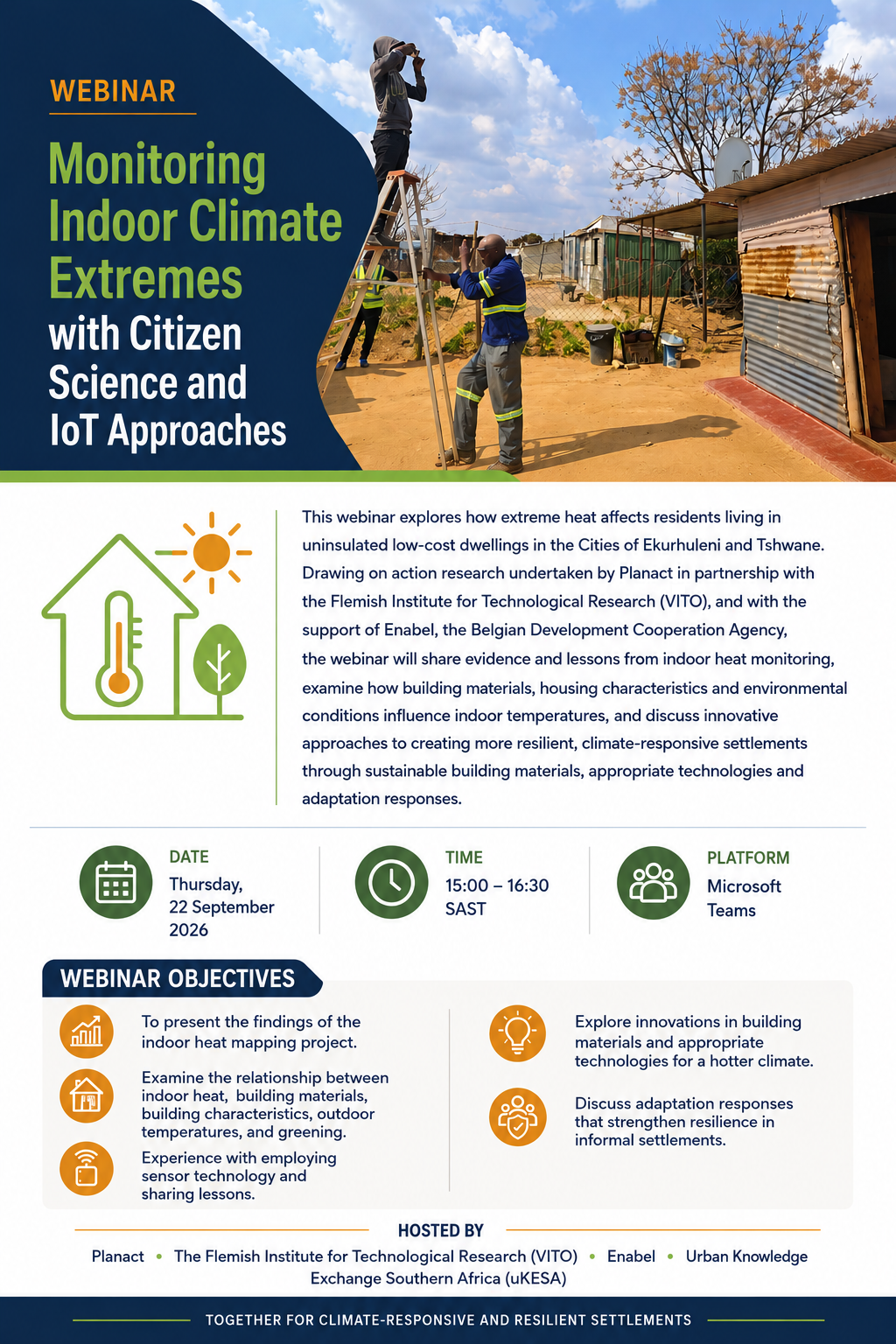
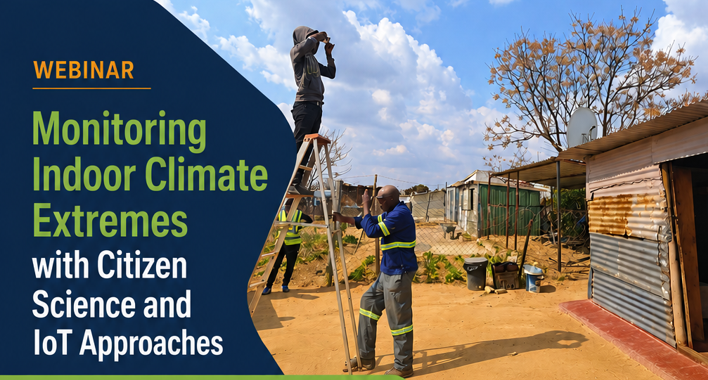
This webinar explored how extreme heat affects residents living in uninsulated low-cost dwellings in the Cities of Ekurhuleni and Tshwane. Drawing on action research undertaken by Planact in partnership with the Flemish Institute for Technological Research (VITO), and with the support of Enabel, the Belgian Development Cooperation Agency, the webinar took place on 7 October 2026 from 15:00 to 16:30 SAST. The study examined how building materials, housing characteristics and environmental conditions influence indoor temperatures, and discussed innovative approaches to creating more resilient, climate-responsive settlements through sustainable building materials, appropriate technologies and adaptation responses. The webinar presented the findings from this study and shared evidence and lessons from indoor heat monitoring.
Webinar objectives were to:
- Present the findings of the indoor heat mapping project.
- Examine the relationship between indoor heat, building materials, building characteristics, outdoor temperatures and greening.
- Share experiences of employing sensor technology and lessons learned.
- Explore innovations in building materials and appropriate technologies for a hotter climate.
- Discuss adaptation responses that strengthen resilience in informal settlements.
Key outcomes of the webinar:
The study confirmed that indoor heat exposure is a significant and growing challenge in low-income and informal settlements, with indoor temperatures frequently exceeding comfort thresholds and, in some cases, surpassing 40°C. Findings showed that metal dwellings experience substantially higher daytime temperatures than masonry houses, highlighting the critical role of building materials in shaping indoor thermal conditions.
The webinar demonstrated the value of combining citizen science and IoT-based monitoring, with community members actively participating in the installation and monitoring of 150 sensors across two Gauteng settlements. Participants agreed that sufficient evidence now exists to move beyond monitoring and towards implementing practical adaptation solutions.
Key recommendations included integrating climate and heat risks into informal settlement upgrading programmes; testing low-cost interventions such as insulation, ceilings, improved ventilation, reflective roofing materials and shading; strengthening community-led adaptation and innovation; and building stronger links between research, policy and implementation. The discussion also emphasised the need to prioritise vulnerable groups, including children, older persons and people with chronic health conditions, while expanding future research and adaptation initiatives across South Africa.
Speakers bios
- Ms Tamzin Hudson is a Programme Manager at Planact whose work focuses on the intersection of urban development, housing, informal settlements, governance and community participation. She has experience working with communities on housing and human settlement issues, informal settlement upgrading, basic service delivery, urban resilience and policy advocacy. Her current work includes exploring climate and heat resilience in vulnerable urban communities and the relationship between housing and the built environment and public health. Tamzin previously worked in diplomacy for the South African government and has also worked with international NGOs on democracy, human rights and women's political participation.
- Mr Jan Theunis is a bio-engineer who works at VITO since 1999. After working for five years on policy studies in the field of emissions and environment, he worked for several years on in- and outdoor air quality using standard and innovative sensors and monitoring approaches. He gradually expanded his work towards the impact of the environment on human health. Since April 2025 he focuses on the impacts of climate change, i.e., heat, on human health, and on possible adaptation policies and measures.
- Mr Sacha Takacs holds an MSc. in Ecology, Evolution and Conservation from Imperial College London and another master as Electromechanical engineering from the Catholic University of Leuven. Through his work, he gained strong knowledge in satellite data analysis, using deep learning, machine learning techniques in order to solve ecological problems. Since he joined VITO, he has been pursuing research on urban heat stresses using measurements and climatological models. His work at VITO focuses on African cities. Furthermore, he is developing heat-stress sensors (prograde and hobby sensors) to improve the accuracy of the measurements done in African projects.
Presentation
You can download the presentaton here (PDF, 2.88MB).
Respondents
- Dr Coralie van Reenen is a Professional Architect, holding a doctoral degree from the University of Pretoria, and is the Research Group Leader of the Infrastructure Innovation Research Group at the Council for Scientific and Industrial Research (CSIR). Her research considers health, well-being and sustainability in the built environment, with a focus on driving the digital transformation and performance monitoring. She is active in promoting innovation and transformation in the human settlements and public infrastructure sector. As a Green Star Accredited Professional, Coralie has a thorough understanding of the principles of sustainable design, in terms of social, economic and environmental sustainability. She has experience in the development of norms and standards, design guidelines, and policies, and in the implementation of innovative building technologies.
- Dr Jan Hugo is a registered architect and senior lecturer in the Architecture Department at the University of Pretoria. His current research focuses on the role of the built environment in developing climate change resilient cities, specifically heat health solutions. He currently coordinates the Professional Master's in Architecture programme at UP and participates in the Climate-resilient Urban Environments research group, the CIB SASBE Working group, and the CIB Nature-based Solutions for Climate Resilience Task Group. Jan Hugo has contributed to several inter- and transdisciplinary research projects focused on climate resilience in marginalised communities and is a Y-rated NRF researcher.
YouTube
You can watch the webinar on our YouTube channel by following this link.
 View all Events