
A New Strategy of Sustainable Neighbourhood Planning
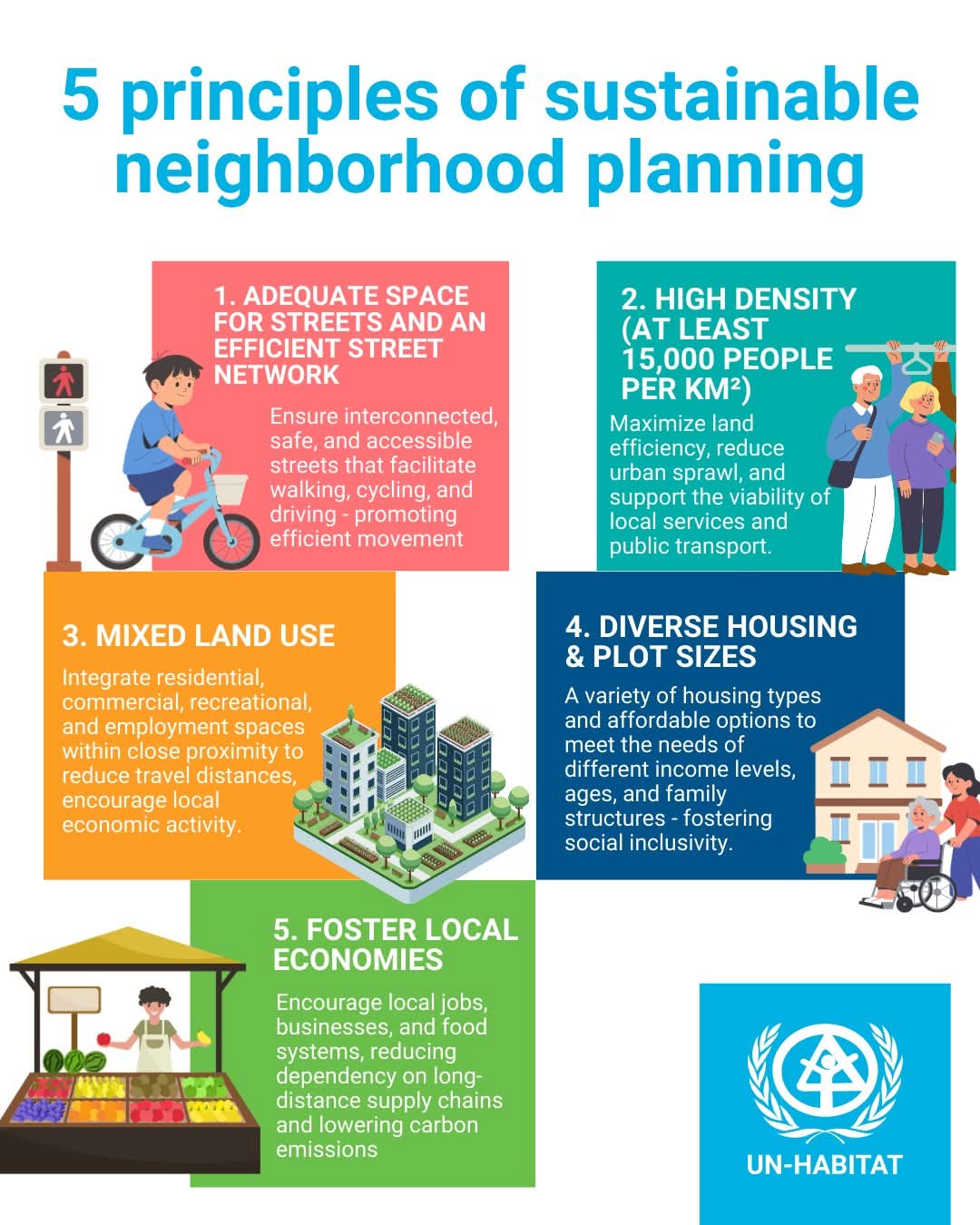
UN‑Habitat supports countries in developing urban planning methods and systems that respond to today’s most pressing urbanisation challenges, including rapid population growth, urban sprawl, poverty, inequality, pollution, congestion, and issues related to biodiversity, mobility, and energy. To guide cities toward more sustainable futures, UN‑Habitat promotes an approach grounded in five core principles designed to advance three key features of sustainable neighbourhoods and cities: compactness, integration, and connectivity. These principles are:
- Allocating adequate space for streets and ensuring an efficient street network,
- Achieving high residential density of at least 15,000 people per km²,
- Promoting mixed land use,
- Fostering social mix through diverse housing options, and
- Limiting land-use specialisation
These five principles work together to create vibrant, inclusive, and efficient urban environments capable of supporting equitable growth and long‑term resilience.
An elaboration of this publication has been undertaken providing additional principles of neighbourhood design which can be found here.
Abstract based on original source.


Comments