
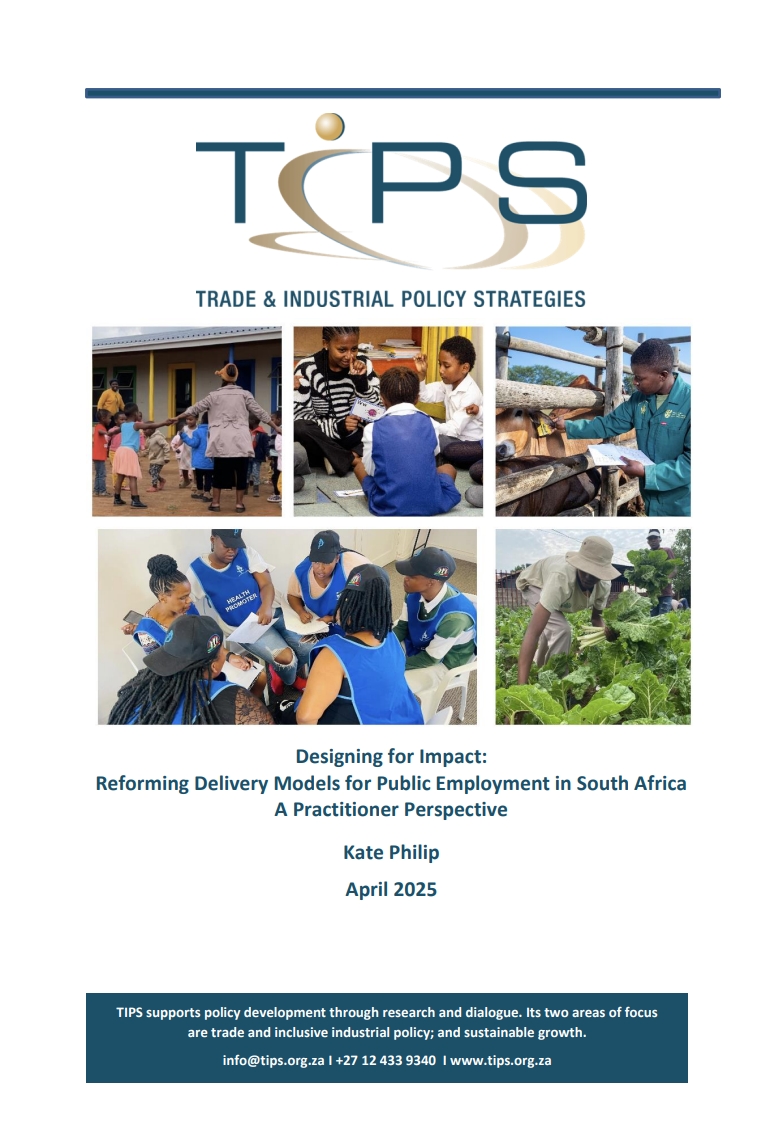
Designing for Impact
Reforming Delivery Models for Public Employment in South Africa A Practitioner Perspective
01 April 2025
Trade & Industrial Policy Strategies (TIPS)
English
Research report
Africa
The study explores why South Africa must adopt a green structural transformation pathway to achieve sustainable, inclusive economic development. It explains that while high-income countries historically industrialised through fossil-fuel-intensive growth, this model is no longer viable due to global climate constraints, shifting geopolitics, declining financing for fossil fuels and emerging carbon-related trade barriers. South Africa, despite its modest contribution to global emissions, remains highly carbon-intensive and has experienced weak investment, limited structural transformation and persistent inequality since apartheid. The paper argues that green industrialisation supported by active, adaptive industrial policy is the only feasible route to escape carbon-heavy stagnation, reduce risks, and unlock new opportunities in higher value-added, labour-absorbing and export-competitive sectors.
Abstract based on original source.


Comments